

When your walls are stained waiting to be refreshed, when your car’s paint has lost its shine, when a handcrafted wooden table craves a delicate layer of protection — choosing the right spray tool often determines the ultimate outcome more than the color mix. I believe most of us have been puzzled by those spraying technical questions: what do HVLP and LVLP stand for? What scenarios are they suited for?
Well, don’t worry, this article will systematically analyze the core principles, performance differences, and selection strategies of these two types of spray guns in practical applications, while extending the discussion of the key differences between HVLP and Airless spraying to help you make the best decision based on your specific needs.
What is HVLP spraying?
HVLP spray technology, which was defined by SCAQMD way back in the 80s, has now been adopted by most US state EPAs. Simply put, HVLP (High Volume Low Pressure) uses a high volume of low-pressure air for atomization. This creates a softer spray pattern that reduces environmental pollution and material waste. To wrap your head around it, you can just picture it as a gentle, high-volume air stream that efficiently deposits paint onto the surface instead of bouncing off and creating messy overspray. HVLP guns typically feature larger air passages and multiple/larger atomizing orifices. To meet the requirements, the air pressure measured at its air cap must not exceed 10 PSI (per Square Inch) (and is typically between 0.1 and 10 PSI), or the transfer efficiency must reach at least 65%. Compared to conventional airspray guns, this significantly cuts down on overspray and waste.
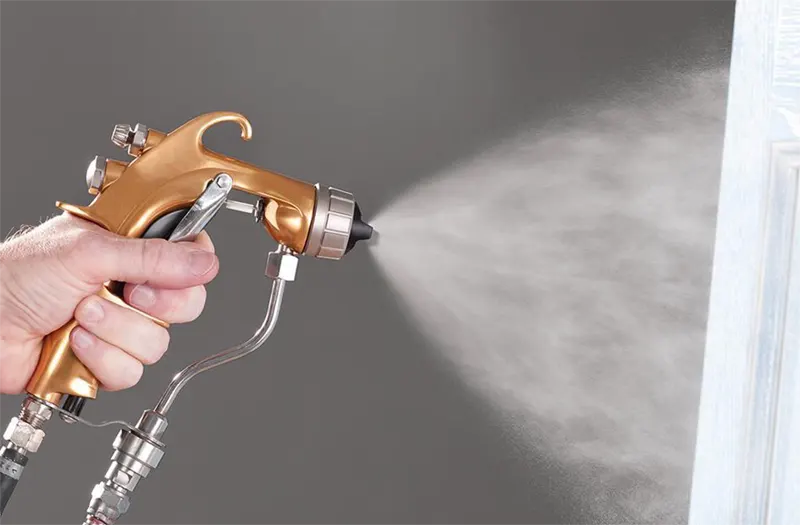
HVLP spray gun
Ever wondered what makes HVLP spray guns game-changers for a smooth, efficient finish? It starts with a turbine or compressor producing a large volume of air. Some of the air goes to the gun’s nozzle/air cap, and some enters the paint container. Inside the container, it pressurizes the space above the paint, pushing it up the suction tube. Now, here’s where the magic happens: right at the nozzle outlet, this high-volume, low-pressure air meets the incoming paint stream. This lead to the paint being atomized into incredibly fine particles – we’re talking a super-fine mist in the 15-20 micron range! This instantly creates the actual spray pattern you see. And there’s a crucial extra trick: as the particles and air shoot out, the particles are enveloped by an “air jacket”. This minimizes overspray and boosts material transfer efficiency, resulting in better coverage, less wasted material, and savings in time, money, and cleanup.
Thanks to its gentle spraying characteristics, the HVLP spray gun has a vast array of uses in the following fields:
- Furniture and wooden products: HVLP is widely used in painting high – end solid wood furniture. Its precisely regulated pigment adhesion ensures clear wood grains and uniform color coverage. It also meets the complex requirements of wooden handicrafts and musical instruments. For those demanding both aesthetics and acoustic performance, HVLP’s low – pressure atomization avoids over – coating and provides a perfect, particle – free finish.
- Equipment and Manufacturing Coating: HVLP suits applying anticorrosive coatings to metal parts, offering uniform coverage in gaps and corners to reduce leakage risk. Many household items like automobile dashboards, refrigerator panels, and air conditioners benefit from it. And if you are a car enthusiast, then you might also be quite familiar with this spray gun. Yes, it is also used for automotive refinishing.
- Architecture and Decoration: HVLP is used in high-end architectural paint, ideal for matte art paints’ textures and complex shapes. It’s often used in exterior building painting and balcony guardrail corrosion protection. For real stone paint, it helps control sand particle density to mimic natural stone texture. It also reduces paint splashing in fluorocarbon paint spraying, improving safety.
This type of spray gun demonstrates superior performance in multiple aspects when compared to other spraying methods:
- High Transfer Efficiency: Conventional high – pressure spraying only manages to utilize 30% – 40% of the paint because of all the spattering. On the flip side, HVLP uses low – pressure atomization through special nozzles, which significantly cuts down on spattering. This allows it to achieve an impressive 65% – 85% paint utilization, slashing both costs and waste.
- Superior coating quality and fine surface effect: HVLP’s low – pressure atomization guarantees a uniform coating particle diameter. It reduces the “orange peel” and “graininess” , thus helps to make a more translucent varnish layer with higher color saturation in the paint layer.
- Construction safety and environmental protection advantages: HVLP minimizes paint droplet dispersion, reducing workers’ inhalation risk, and decreases paint volatilization (VOC emissions) to meet environmental regulations.
- Operational flexibility and wide range of application: The HVLP spray gun is highly adaptable to the substrate, can spray metal, wood, plastic, leather, textiles and other materials. Plus, it is capable of fine work, spraying lines just 0.5cm wide, making it ideal for handcrafted artwork featuring small models.
Of course, this spraying method also presents certain drawbacks:
- Lower efficiency, less suitable for large – area fast work: The unavoidable minus of a super – careful work style is a drop in efficiency. Due to the low-pressure constraints, the paint output of HVLP in a single spray is considerably lower than that of other types of spraying. Additionally, to avoid sagging, HVLP frequently utilizes a “thin layer” technique, which prolongs the overall drying time for multiple coats.
- Limited adaptability to high-viscosity coatings: HVLP has very strict requirements for coating dilution. When spraying undiluted anticorrosive paints or thick slurry-type coatings, HVLP requires adding a diluent to ensure proper atomization. This renders the use of an HVLP spray gun for high-viscosity coatings rather challenging.
- Complexity of the equipment system and higher initial investment: HVLP has stricter requirements for supporting equipment. Apart from spray guns, this technique requires special air compressors (10 – 25 CFM), pressure – stabilizing valves, and oil – water separators. These extra components result in a higher overall cost for the HVLP system.
- Higher requirements for operation, novices easy to defects: This is also an aspect that DIY enthusiasts need to pay extra attention to, HVLP parameter adjustment is relatively complex. It requires precise control of air pressure, paint flow, and the distance between the spray gun and the surface (15 – 25 cm). Novice errors, such as improper parameters, can lead to low air pressure resulting in “pulling” or “piling of paint.” Alternatively, if the flow is too large, it can cause the wet film to be too thick, resulting in flow hanging.
What is LVLP spraying?
Moving to LVLP, or Low Volume Low Pressure spraying technology, it shares significant similarities with HVLP as it also uses low-pressure operation to atomize paint. However, compared to HVLP, it consumes a lower volume of air and operates at a slightly higher air pressure. This makes LVLP guns a perfect fit for users who have smaller air compressors.
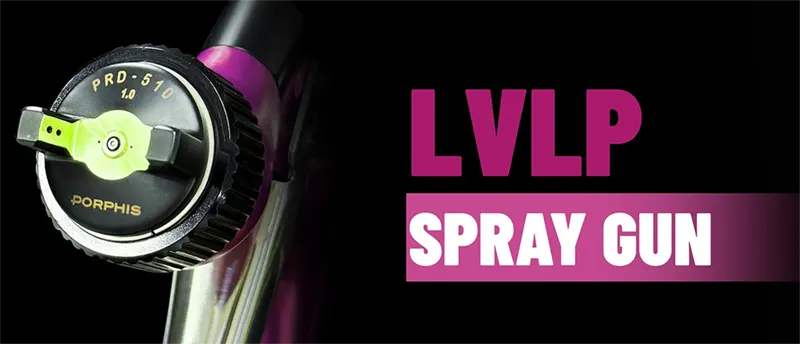
LVLP spray gun
Similarly, the LVLP spray gun also relies on the design of air caps and nozzles for paint atomization. However, the air cap of the LVLP spray gun features smaller atomization holes but a wider air passage. This design creates a higher local pressure, pushing the paint to flow through the nozzle at a high speed, achieving a more refined atomization effect. Beside, to achieve satisfactory atomization, its paint sprayer requires a lower air volume (typically 5 – 18 CFM) and a lower inlet air pressure (10 – 30 PSI) for actuation.
After understanding the definition and usage principles of this spray gun, I bet now you are more curious about its application scenarios. Well, you may consider them as achieving that optimal equilibrium:
- Automotive Refinishing and Fine Spraying: The LVLP system offers top – notch atomization and high – speed spraying, making it a perfect fit for automotive painting operations where efficiency is absolutely crucial.
- Industrial Painting: It is also suitable for industrial production lines that require a balance between spraying speed and paint utilization.
- DIY Projects: If you enjoy making some small handicrafts in your daily life, then this is exactly what you’re looking for. Owing to its relatively low demand for air compressors, the LVLP is highly favored by home users and small studios.
Meanwhile, I’ve also briefly listed the advantages of this technology for you. Taking these points into account will help you make a comprehensive assessment:
- Superior Atomization: The LVLP can achieve outstanding paint atomization even with lower air volumes.
- Higher Spraying Speed: Compared to HVLP, the LVLP typically boasts a faster spraying speed, thereby enhancing work efficiency.
- Relatively Low Air Compressor Requirements: Reduced air consumption allows for the use of less powerful air compressors.
- Efficient Paint Utilization: Similar to the HVLP, the LVLP is as effective in minimizing overspray and improving paint utilization when compared with typical conventional air – spray guns.
What is the difference between HVLP and LVLP?
Although both HVLP and LVLP fall into the realm of low – pressure spraying technologies, there are some significant differences between them. To put it simply, HVLP is all about “high volume, low pressure”, striving for the maximum transfer efficiency and the minimum overspray. Meanwhile, LVLP, on top of “low volume, low pressure”, places more emphasis on attaining excellent atomization and a quicker spraying speed while using less air.
The following table makes a relatively intuitive comparison:
| Features | HVLP (High Volume Low Pressure) | LVLP (Low Volume Low Pressure) |
| Air cap pressure | Low (usually below 10 PSI) | Lower than HVLP (usually at the inlet of 10 – 30 PSI) |
| Air consumption (CFM) | High (10-25 CFM) | Lower (5-18 CFM) |
| Transfer efficiency | Very high | High |
| Atomization effect | Fine | Good, may be slightly inferior to top – level HVLP |
| Spraying speed | Relatively slow | Faster |
| Requirements for the compressor | High | Relatively low |
| Suitable scenarios | Fine woodworking, automotive fine spraying, occasions with high requirements for overspray control; Regular DIYers and beginners; | Automotive refinishing, industrial painting, DIY projects; Experienced DIYers and professional users; |
| Paint types | Wide range, but high – viscosity coatings may need to be diluted | Wide range, performs well with medium – and low – viscosity coatings <br> |
Which one to choose between HVLP and LVLP spray guns?
Even after the above understanding, I believe there are still many people who wrestle with the choice between an HVLP and an LVLP spray gun. “Which one will give me that perfect finish?” “Which one’s best for my project?” “My compressor is tiny… what do I do?!” Are these the questions you’re currently thinking about?
Well, both boast impressive performance, but the “best” choice really hinges on your unique needs and setup. Let’s break it down, ditching the dry summaries and diving into real-world scenarios:
Application Focus & Surface Quality Requirements.
Choose HVLP: If you’re all about fine woodworking or high – gloss automotive finishes, or you’ve got a project that just has to have an absolutely flawless surface with hardly any texture (you know, no “orange peel” allowed), and you’re super into cutting down on overspray and VOC emissions for the environment or your health. HVLP is the way to go. It does an amazing job of fine atomization and has high transfer efficiency. It’s like the secret key to getting that top-notch, super smooth result when perfection is a must.
Spraying Effect & Finish Goals.
Choose HVLP: When the ultimate surface smoothness and minimal material waste are super important. Its gentle, low – pressure atomization is like a pro at laying down material evenly and efficiently. It gets more paint on the target and less floating around in the air. This immediately leads to a much higher – quality final look, which is especially crucial for topcoats that need high gloss or clarity.
Choose LVLP: If you need good to excellent results but want a faster application speed. LVLP gives good atomization and finish quality (often with really good gloss). But because it’s faster, it has a bit less time for perfect levelling compared to HVLP’s ultra – fine mist. However, it’s still way more efficient than conventional spray guns.
Project Scale & Air Compressor Capacity.
If you need to cover large areas quickly (large panels, furniture sets, production work) or if your air compressor has limited capacity (lower CFM output). The super – awesome thing about LVLP is that it can get the job done much faster and it doesn’t gobble up a ton of air. That means you can still be super productive even if you’re using a smaller compressor that might have a hard time keeping an HVLP gun running smoothly all the time.
Paint Type & Job Role.
Choose HVLP for Primers: HVLP is often the ideal tool for applying primers and basecoats. Its high transfer efficiency means it gives awesome coverage and sticks like glue, while cutting down the airborne primer mist (overspray) big time. This creates a rock – solid base for the layers to come.
Choose LVLP for Clear Coats: LVLP really stands out when putting on clear coats, especially over large areas. It can give amazing gloss and a smooth flow, and its built – in faster spraying speed is a huge plus for quickly and evenly covering large surfaces with clear. It also lowers the chance of getting dust nibs or uneven build – up while you’re applying it.
What is airless spraying?
Although HVLP and LVLP can already cover most usage scenarios in daily life, there are still some annoying times: Your HVLP gun gets clogged when you’re using thick latex paint. The compressor has a hard time working when trying to cover the warehouse wall. And the deadlines are getting closer. Does this situation ring a bell? Then that’s when we should look for a new painting technology, airless spraying – a method that isn’t affected by paint viscosity and can help you finish the projects on time.
To understand this type of spraying gun, the first thing is to forget about the compressor. Airless spraying takes a totally different route when it comes to painting. Instead of relying on compressed air to spread the paint (like HVLP or LVLP do), this method goes all – out with pure force, and yep, it’s hydraulic force!
Here’s the cool idea: a super – strong high – pressure pump (usually powered by electric or gas motors) acts like a turbo – charged heart. It directly pressurizes the paint to super high levels, just try to imagine thousands of PSI. Then, this super – pressurized paint zooms at high speed through a tiny, precision – engineered spray tip (that’s the nozzle). As the paint shoots out from this little hole under crazy pressure, it instantly atomizes into a fine, fan – shaped spray pattern.
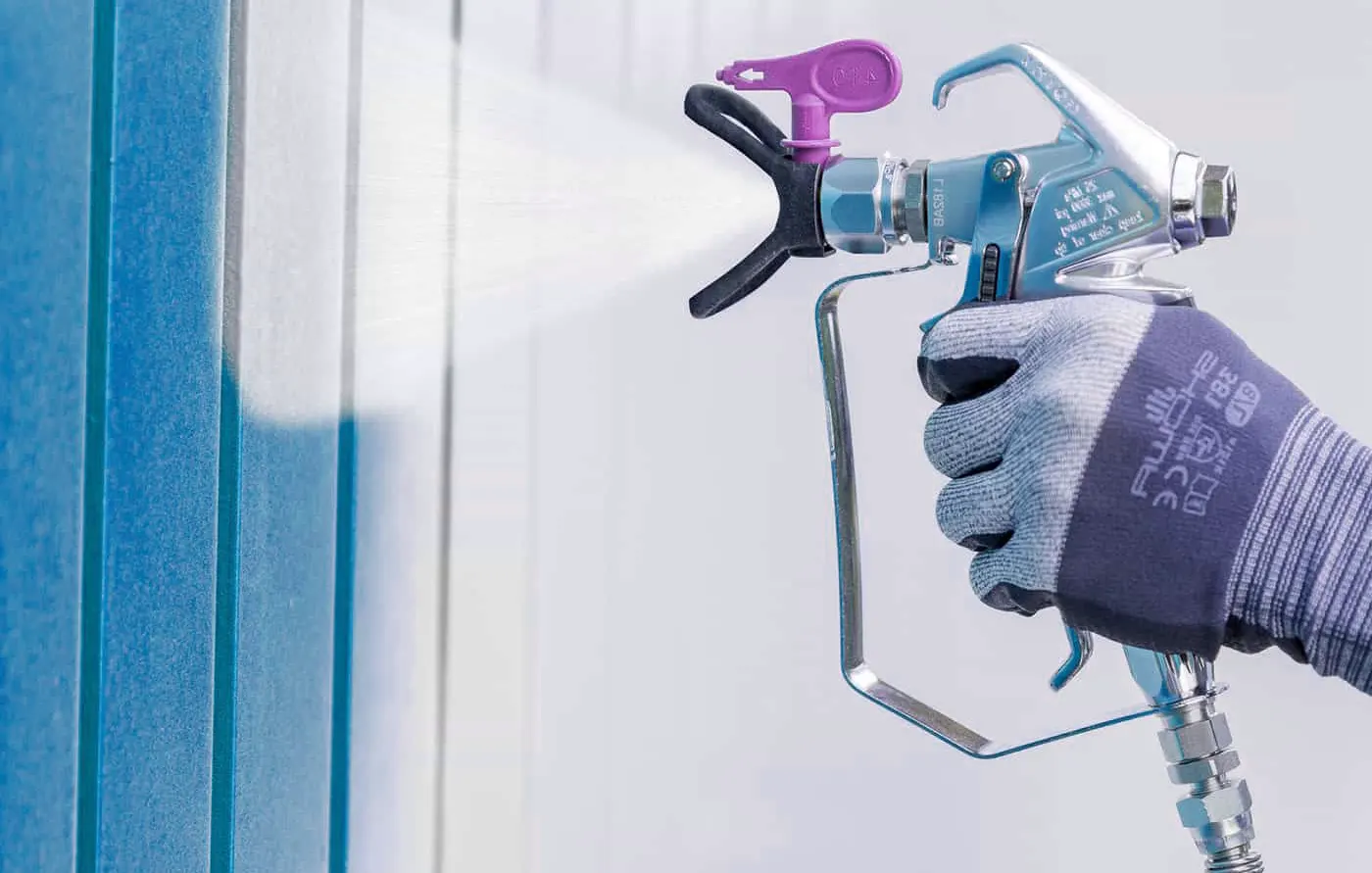
airless spraying
Why go airless? The key advantages are all about power and speed:
- Sheer Muscle for Tough Jobs: That high – pressure system just scoffs at thick, sticky coatings. Latex paints, heavy – bodied primers, gooey sealants, elastomeric coatings – materials that would make conventional sprayers choke or struggle – are dealt with like a walk in the park.
- Blazing Speed & Efficiency: By pressurizing the material straight up and flinging it out forcefully, airless sprayers have amazing material output rates. They can cover huge areas in the blink of an eye – we’re talking gallons per minute splashing onto the surface. This makes them the unbeatable champs when it comes to productivity.
- Reach & Coverage Power: The high – speed action gives the spray awesome projection and penetrating power. It can easily zoom into crevices, cover bumpy surfaces, and handle big, flat areas without breaking a sweat.
Airless Vs HVLP Spray Machines.
An experienced contractor, have to repaint a huge warehouse ceiling. And you choose to pick up your reliable HVLP sprayer – it’s awesome for cabinets, isn’t it?
If that’s what you’re thinking, then here’s what’ll go down: The thick industrial primer keeps clogging the tip. The progress is slower than a snail. Your crew ends up spending more time cleaning the guns than actually spraying. The deadline vanishes into thin air, penalties start piling up, and the client is fuming mad. Thousands of dollars down the drain, all because “sprayer” didn’t mean “the right sprayer”.

Airless Vs HVLP Spray Machines
That painful lesson is practically shouting the truth: Choosing between Airless and HVLP isn’t just about what you like – it’s about avoiding costly disasters. If you slap the wrong machine onto the job, you’ll be battle clogs, waste gallons of that expensive material, miss your deadlines, and totally butcher the finish.
Skip the guesswork and the horror stories. Here’s your cheat sheet comparing these machines:
| Features | Airless Spraying | HVLP (High Volume Low Pressure) |
|---|---|---|
| Atomization Method | High-pressure forced injection of paint through the nozzle | Low-pressure air mixes with paint for atomization |
| Spraying Pressure | Very high (hundreds to thousands of PSI) | Low (below 10 PSI at the air cap) |
| Air Consumption (CFM) | None (does not rely on compressed air for atomization) | High (10 – 25) |
| Transfer Efficiency | Medium, with more overspray | Very high, with less overspray |
| Atomization Effect | Coarser particles, surface finish may be inferior to HVLP | Fine, high surface finish |
| Spraying Speed | Very fast | Relatively slow |
| Compressor Requirements | None (requires a high-pressure pump) | High (requires a large-capacity air compressor) |
| Applicable Scenarios | Large-area rapid coating, spraying of high-viscosity paints | Fine coating, occasions with high requirements for paint mist control and surface finish |
| Safety | Higher risk when operated incorrectly (high-pressure injection) | Relatively safe |
| Paint Transfer Rate | 60% | Approximately 90% |
After this in-depth discussion, I believe you have found that HVLP, LVLP and airless spraying are like three craftsmen with their own unique skills – HVLP is the artistic master in pursuit of excellence, LVLP is the practical expert in efficiency, and airless spraying is the industrial giant that conquers the big scene. Each technique has unique advantages in its own exclusive field, and as often professional painters say, “There is no such thing as the best spray gun, only the fittest one.”
We look forward to seeing the amazing works you create using these tools! If you encounter any technical difficulties in practice, or would like to obtain outsourced painting services, you can use the coatingsdirectory database to select suitable vendors to handle your needs—completely free of charge!
FAQs
Does hvlp use more paint than airless sprayer?
In most situations, HVLP saves more paint than airless spray because of its high transfer efficiency and precise coating control. But when you’re working with thick, undiluted coatings or large, single – application thick coats, airless spraying might have an edge in terms of dosage.
Is hvlp better than lvlp?
The definition of “better” depends on specific needs. HVLP is better than LVLP in terms of efficiency, paint utilization, and applicability, making it a great fit for professional or medium – to – large scale projects. LVLP has a low entry barrier, low cost, and low energy consumption, so it’s well – suited for small – scale fine work or non – professional scenarios.
Does HVLP waste more paint?
No, when operated correctly and with matched parameters, the HVLP system has significantly less paint waste. It minimizes waste by enhancing atomization and adhesion efficiency, particularly for professional jobs where paint costs are critical.
Is airless spraying more suitable for large surfaces?
Yes, airless spraying is a better choice for spraying large surface areas. The paint is directly delivered by a high – pressure pump and doesn’t need compressed air for atomization.
Why do I need to strain paint before putting it in a spray gun?
Straining removes clumps or debris that will clog the spray gun’s nozzle. Paint, especially if stored, can contain small lumps, dried flakes, or impurities. Pouring it through a mesh paint strainer ensures only smooth liquid enters the sprayer, preventing clogs, spitting, and ensuring an even spray pattern.
How do I test if my paint is thin enough for a spray gun?
Use a viscosity cup or do a spray test on cardboard. A viscosity cup measures the time it takes for paint to drain, indicating thickness (check gun manual for ideal times). Alternatively, spray the thinned paint onto a test surface; it should form a fine, even mist without sputtering (too thick) or running excessively (too thin).